.png?width=187&height=40&name=AppVentory%20Logo%20(White).png)
What you get
A clearer view of how AppVentory builds its overall data picture — where apps, users, usage signals, organisations and spend come from, and what each source can and cannot reveal.
The two main discovery sources
AppVentory builds the strongest picture when identity/workspace data and accounting data are both connected.
Identity/workspace data tells AppVentory about the people and application side of the stack. Google Workspace and Microsoft Entra ID can contribute users, identity-linked applications and available activity/sign-in signals; Okta contributes users and applications assigned through Okta.
Accounting data tells AppVentory about the financial side. Software-related vendors and transactions can be matched to applications, while connected organisations provide the scope that spend belongs to.
Put together, the two sources answer different parts of the same question:
- Identity / Workspace — Users, applications, user-to-app relationships and available usage/activity signals
- Accounting — Organisations, software vendors/apps, spend and transactions
- Browser extension — Additional browser-based usage evidence
- CRM / Practice CRM — Client onboarding and client records — not a core app-discovery source
- Email provider — Communication delivery — not a core app-discovery source
- Manual import — Apps you add when connected sources do not cover them
The important mental model is: identity/workspace tells AppVentory what people are connected to and using; accounting tells AppVentory what the organisation is paying for. AppVentory brings those views together into one inventory.
The four tabs
- All Apps — Everything AppVentory knows about
- In-Use — Confirmed. Counts towards spend and appears in findings
- Discovered — Found, not yet confirmed
- Inactive — Retired, history kept
In-Use versus Discovered is the distinction that matters. Confirming an app is how the list becomes yours rather than the system's guess.
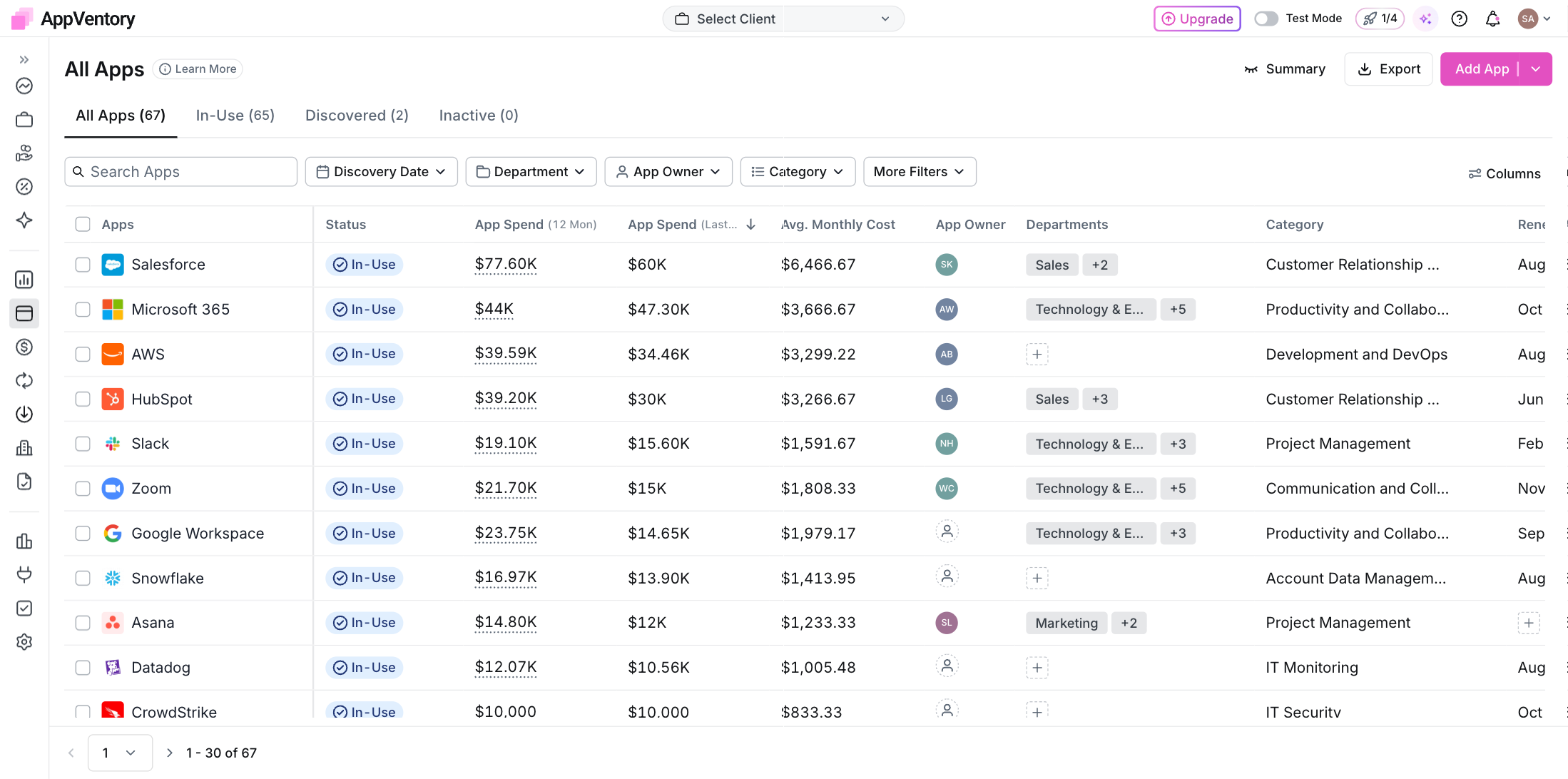
Apps list with the four tabs and the summary strip
Why review still matters
Connected sources are evidence, not a perfect master list. Accounting vendor names can differ from product names, an identity provider only sees apps within its own boundary, usage evidence depends on the connected source, and manually added records can create duplicates if you do not search first.
What you've unlocked
You now know which parts of the inventory are system-derived and which still need your judgement.